

Open any college WhatsApp group today, and you’ll inevitably see someone asking, “Which AI app should I actually use for studying?” Fair question. Hundreds of apps claim to be the ultimate student hack, yet most just repackage the same three basic features.We’re cutting through the noise. Here are five AI study tools that genuinely save you time on notes, research, writing, and revision. We break down exactly what they cost in India, their hidden flaws, and how to use them without failing your college’s academic integrity checks. Whether you’re grinding for board exams, drafting a massive dissertation, or just trying to survive finals week, you’ll find the right fit below.
What Are AI Study Tools, Exactly?
AI study tools rely on large language models to handle heavy academic lifting. Think summarizing dense chapters, clearing up late-night doubts, generating custom practice tests, fixing grammar, and wrangling research. Let’s be clear: they don’t replace the act of studying. Instead, they strip away the tedious, low-value tasks—like reformatting messy notes or endlessly hunting for citations—giving you more hours to actually learn the material.
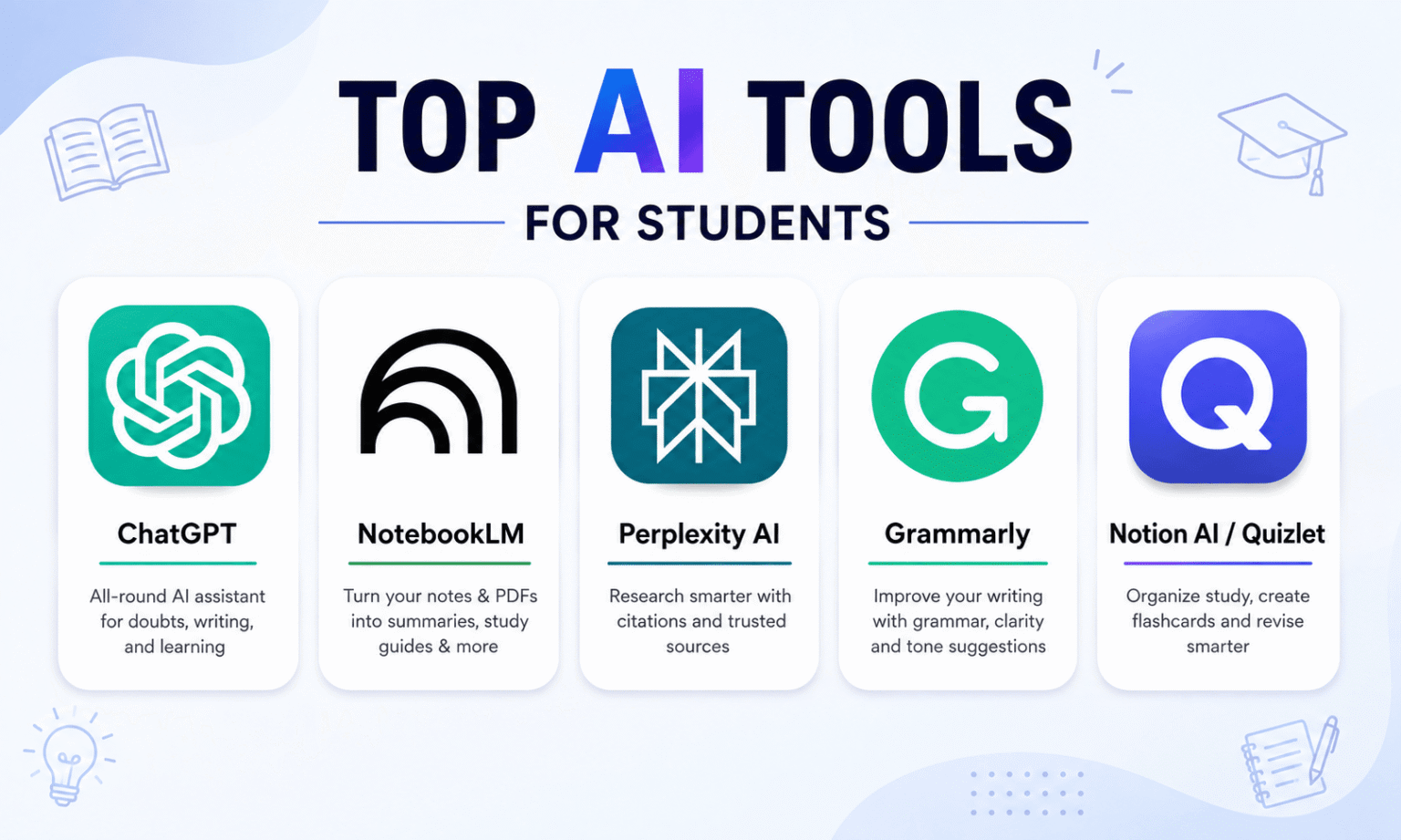
The 5 Best AI Tools for Students in India (2026)
1. ChatGPT — Best All-Round AI Study Assistant
ChatGPT is still the default tool for most students, and rightly so. It tackles everything from brainstorming and essay outlines to code debugging and 2 AM doubt-solving. Its current Study Mode is also designed to guide students through concepts step by step rather than simply handing over an answer.
- Good for: Breaking down tough concepts into plain English, generating practice questions, structuring assignments, and troubleshooting code for CS and engineering undergrads.
- Pricing in India: You can easily get by on the free tier for daily questions. OpenAI introduced ChatGPT Go in India as a lower-cost subscription, and the plan has since expanded globally. Check the official pricing before paying because prices and promotional offers can change.
- Where it falls short: It hallucinates confidently. If you ask about niche Indian syllabus topics—like state board specifics, fresh case law, or hyper-local current affairs—it might just make things up. Double-check its claims against your textbooks.
- Common mistake: Copy-pasting responses straight into your assignment. Beyond the obvious ethical red flags, AI output rarely sounds like a stressed college student. Plagiarism scanners will spot that robotic tone immediately.
2. NotebookLM — Best for Turning Your Own Notes and PDFs Into Study Material
Google built NotebookLM differently. Instead of pulling answers from the wider web, it works around the sources you provide. You can upload lecture PDFs, textbook material, handwritten notes, or research papers and ask questions based on those sources. Google also supports features such as Audio Overviews, flashcards, quizzes, and other study-focused tools.
- Good for: Boiling down massive lecture slide decks, building custom study guides from your exact syllabus, generating audio-style chapter discussions for commuting, and cross-referencing multiple papers for a literature review.
- Pricing in India: The base version is available with a Google account, while higher limits and additional features can depend on the account or Workspace plan. Check Google’s current NotebookLM offering before subscribing.
- Where it falls short: The “garbage in, garbage out” rule applies heavily here. If your uploaded notes miss half the lecture, your AI-generated summary will too.
3. Perplexity AI — Best for Research With Citations
Think of Perplexity as a highly educated search engine. Unlike standard chatbots, it searches the web and provides answers backed by citations and links to original sources. If you’re tackling research-heavy coursework, a thesis, or just need to back up a claim in an essay, this is your go-to.
- Good for: Pulling the latest statistics, mapping out different arguments on a topic, compiling reading lists with actual citations, and rapid fact-checking before hitting submit.
- Pricing in India: The free tier handles everyday research. Keep an eye out for current telecom partnerships and promotional offers because availability and pricing can change. Paid plans are also available for users who need more advanced research capabilities.
- Where it falls short: You still have to do the reading. Just because the AI linked a source doesn’t mean it interpreted the data correctly. Always open the link and read the original context before quoting it.
4. Grammarly — Best for Writing, Grammar, and English Proficiency
Writing in a second or third language is the reality for a huge portion of Indian university students. Grammarly isn’t about letting a computer write for you; it’s about catching those small, annoying errors that professors dock marks for—think messy subject-verb agreement, missing articles, or clunky phrasing.
- Good for: Cleaning up assignment drafts, polishing SOPs and cover letters for study-abroad applications, fixing awkward tone, and running a quick plagiarism scan. It can also help students polish professional documents and optimize their LinkedIn profile when preparing for internships and placements.
- Pricing in India: The free version manages basic spelling, grammar, and clarity just fine. Upgrading to Pro/Plus costs roughly ₹390–400/month if paid annually (about $12/month). Definitely hunt for their student discounts before buying.
- Where it falls short: It loves to strip away your personality. If you accept every single suggestion, your writing will sound perfectly generic. Trust your gut on personal essays and SOPs—your unique voice still matters.
For students preparing for internships and placements, you can also read this guide on optimizing your LinkedIn profile for practical profile-improvement tips.
5. Notion AI / Quizlet — Best for Organizing Revision and Flashcards
We grouped these together because they solve the same massive problem: exam season chaos. Notion AI keeps your life structured—managing timetables, project trackers, and class notes. Meanwhile, Quizlet uses AI to instantly turn dense textbook chapters into fast, effective flashcard decks and practice tests.
- Good for: Mapping out an ironclad revision schedule, instantly converting class notes into flashcards, and grinding through spaced-repetition drills before finals.
- Pricing in India: Notion is totally free for individuals who sign up with a verified student email. Quizlet offers a massive free tier, alongside a low-cost Plus option if you want unlimited AI-generated study sets.
- Where it falls short: Flashcards only test your memory, not your actual comprehension. You still need to sit down and solve actual practice problems, especially for math, physics, or engineering.
Quick Comparison Table
| Tool | Best For |
| ChatGPT | General doubt-solving, writing, coding |
| NotebookLM | Summarizing your own notes/PDFs |
| Perplexity AI | Research with citations |
| Grammarly | Grammar, tone, SOPs |
| Notion AI / Quizlet | Organizing revision, flashcards |
Are AI Tools Allowed in Indian Colleges and Schools?
There is no single nationwide rule. It entirely depends on your campus. Right now, over 60% of surveyed Indian higher education institutions allow students to use AI in some capacity. However, the limits vary wildly. Some colleges cap AI assistance at 10–20% of a research paper, while others haven’t even written a policy yet.
For PhD and postgraduate researchers, academic integrity and plagiarism rules are especially important. The UGC’s regulations on academic integrity and prevention of plagiarism provide an important reference point for higher education institutions in India.
Your safest bet for coursework? Read your specific college’s academic integrity handbook. Disclose your AI use if they ask for it, and never submit raw AI output as your own original analysis. You have to do the heavy lifting to make it yours.
Common Mistakes Students Make With AI Study Tools
- Treating AI as the absolute truth. Never blindly trust facts, dates, or figures, especially when studying for exams. Always cross-check.
- Ignoring disclosure rules. If a professor or journal asks you to list the AI tools you used, list them. Hiding it is a fast track to an academic misconduct hearing.
- Outsourcing the thinking. Having an AI write an answer you barely understand completely defeats the purpose. When the professor asks you to explain it during a viva, you will freeze.
- Leaking private data. Never upload sensitive, unpublished lab data or confidential research into a public AI tool without reading the privacy policy first.
- Using a hammer for every screw. Don’t force one app to do everything. Each of these AI study tools specializes in something different. Pick the right one for the specific task at hand.
How to Use AI Tools Without Losing the Learning Value
- Explain, don’t replace: Ask the tool to break down a confusing concept. Read it, close the tab, and try explaining it out loud to yourself.
- Drafts are just starting points: Generate an outline or a rough draft, but write the final, substantial sections entirely in your own words.
- Verify obsessively: Every statistic or citation needs to be checked against a real textbook before it goes into your graded assignment.
- Always ask “why”: AI handles the “what” perfectly. Exams test the “why.” You still have to build those reasoning skills yourself.
FAQ
Is ChatGPT free for students in India?
Yes, the standard free tier is available in India and handles normal study questions easily. If you want higher message limits or additional features, paid ChatGPT plans are available. OpenAI’s current plan details should be checked before subscribing.
Which AI tool is best for research with proper citations?
Perplexity AI wins this category hands down. It actively searches the web and provides citations and links to original sources, letting you verify claims and build an accurate reading list.
Can I get in trouble for using AI tools in college assignments?
Absolutely, depending on your college’s rulebook. Many institutions have their own policies regarding acceptable AI assistance and disclosure. Submitting AI-generated work as your own can create academic-integrity problems, so check your syllabus and institutional guidelines.
What’s the best free AI study tool for someone on a tight budget?
Pair NotebookLM with the free versions of ChatGPT and Quizlet. Between those three, you can summarize PDFs, solve doubts, and run flashcard drills without spending a single rupee.
Do AI tools replace the need to actually study?
No. They speed up the boring parts—research, organizing notes, and fixing typos. But end-of-semester exams and vivas test what’s inside your head, not your laptop. Relying on AI to generate answers without understanding the core concepts will ruin your grades long-term.
There is no magical “best” tool for everyone. It all comes down to where you’re stuck right now. Confused by a concept? Use ChatGPT. Overwhelmed by lecture PDFs? Fire up NotebookLM. Writing a massive thesis? Switch to Perplexity. Fixing an SOP? Run Grammarly. Panicking before exams? Open Notion AI and Quizlet. Find the AI study tool that fixes your immediate bottleneck, use it to save time (not to skip learning), and always respect your professor’s AI policy.